Four major trends of polyester powder spraying technology - from environmental protection to intelligence
Traditional solvent based coatings are gradually being restricted due to VOC emissions. Powder coating, with its natural advantages of solvent-free and zero VOC emissions, is trans
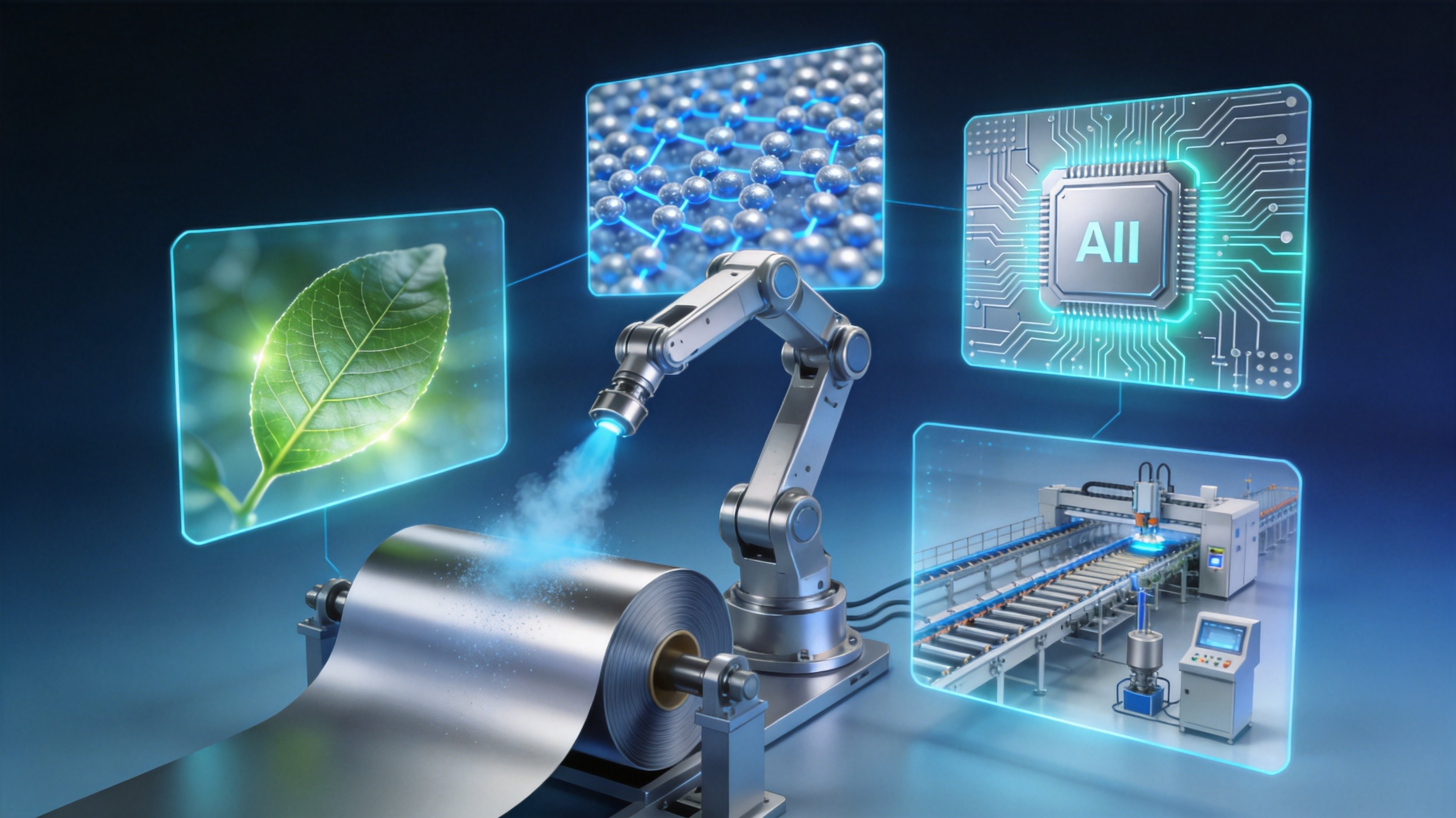
Four major trends of polyester powder spraying technology - from environmental protection to intelligence
1、 Industry Panorama: An Accelerating Fission Market
The global coil coating market is expected to reach a size of approximately 6.44 billion US dollars by 2025 and is projected to reach 10.49 billion US dollars by 2034, with a compound annual growth rate of 5.6% (Fortune Business Insights data). Among them, polyester coatings occupy the largest share due to their cost-effectiveness advantage, accounting for about 32% -37% by 2025. The Chinese market is even more rapid - the scale of the polyester powder coating industry continues to climb from the current about 20 billion yuan, and is expected to exceed the 30 billion yuan mark by 2030, with a compound annual growth rate of 8% -10%.
The core driving force behind this growth is not simply demand expansion, but a fundamental shift in technological paradigms. The following four trends are reshaping the industry.
2、 Trend 1: Environmental Protection - VOC Emission Reduction and Green Transformation
Traditional solvent based coatings are gradually being restricted due to VOC emissions. Powder coating, with its natural advantages of solvent-free and zero VOC emissions, is transforming from an optional option to a mandatory one.
Key progress:
Biobased polyester powder: using castor oil and soybean oil as raw materials, reducing petroleum dependence and lowering carbon footprint by more than 30%
Low temperature curing technology: The traditional curing temperature is above 200 ° C, and the new generation of low-temperature curing powders can be reduced to 160 ° C, saving 25% energy and expanding the application range of thermal sensitive substrates
It is expected that by 2028, the market share of environmentally friendly products will exceed 40% (industry research data)
3、 Trend 2: Intelligence - AI+Automated Spray Coating
The intelligence of the spraying process is a key breakthrough in improving quality and efficiency. Traditional spraying relies on operator experience, making it difficult to ensure coating consistency; Nowadays, robot spraying combined with AI vision systems is changing this situation.
Technological breakthrough:
Machine vision+AI parameter optimization: Real time analysis of spray voltage, flow rate, distance, automatic adjustment of path, reducing defect rates such as sagging and pinholes by more than 60%
Online detection closed-loop: real-time monitoring of coating quality through laser thickness measurement and infrared imaging, achieving fully automatic closed-loop spraying detection adjustment
Digital twin production line: Virtual simulation optimizes production parameters, reduces trial and error costs by 80%, and shortens new product introduction cycle by 50%
4、 Trend Three: Functionalization - From Decorative Anti corrosion to Multi functional Integration
Polyester powder coating is no longer only responsible for appearance and rust prevention, but extends towards high functionality:
6. Antibacterial coating: adding silver ions and zinc oxide nanoparticles, suitable for medical and food scenarios
7. Self cleaning coating: Nano titanium dioxide photocatalytic degradation of pollutants, outdoor buildings do not need to be cleaned for 5 years
8. Thermal conductivity/insulation coating: filled with boron nitride and aluminum oxide, with dual functions of electronic heat dissipation and insulation
9. Wear resistant and scratch resistant coating: ceramic particle reinforcement, preferred for automotive parts and home appliance panels
10. Thermal insulation reflective coating: high infrared reflectivity, building roof can reduce indoor temperature by 5-8 ° C.
5、 Trend 4: Integration - Process Integration and Efficiency Revolution
The traditional spraying process involves pre-treatment (degreasing, phosphating), spraying, and curing, with three independent steps that require a large amount of land, high energy consumption, and low efficiency. The integrated production line is breaking through this bottleneck:
Pre treatment spraying curing continuity: single line production capacity increased by 40%, footprint reduced by 35%
Roller coating+powder spraying composite process: primer roller coating+surface layer powder spraying, balancing efficiency and coating thickness control
Quick color change system: automatic powder recycling+color bin switching, color change time compressed from 45 minutes to 8 minutes, meeting the needs of small batches and multiple varieties